Photo by Peter Kleppin
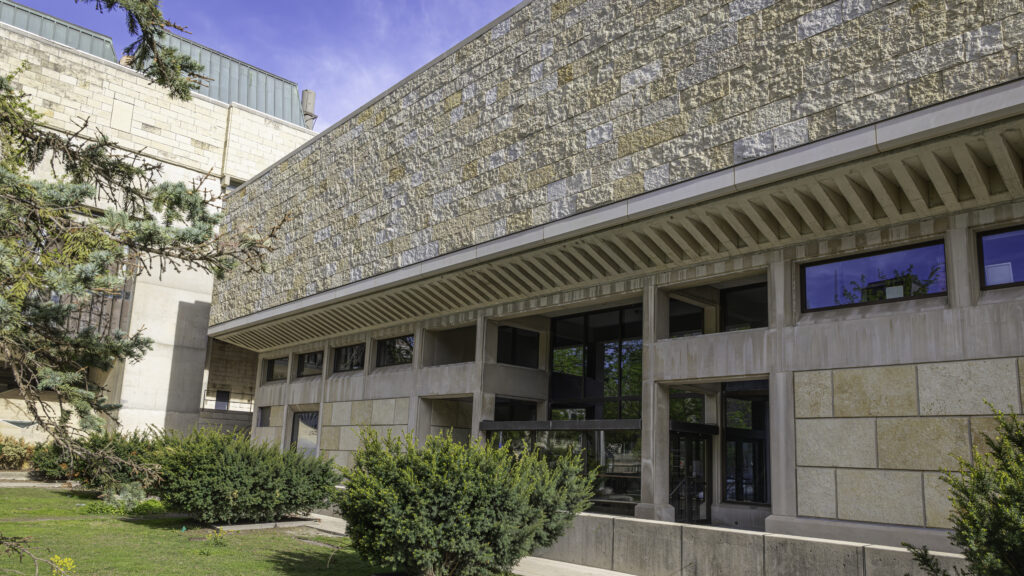
After four long years, the lattice of scaffolding obscuring the Chazen Museum of Art’s Conrad J. Elvehjem Building has finally come down. A trained eye might notice that the exterior stone cladding looks new, but other than that, it would seem not much has changed. In fact, the opposite is true.
As it turns out, this much-needed exterior construction is only part of an ongoing, large-scale reimagining of the museum’s permanent collection that will shift the way patrons experience the Chazen into the future.
The extensive renovation project in the older of the museum’s two buildings, the Elvehjem, unfolded behind scaffolding, inside the building’s walls and on its roof and skylight systems. It involved thousands of work hours, tons of materials, and highly specialized knowledge and craftsmanship, all resulting in improved energy efficiency and climate control. These improvements make the Elvehjem a more temperate place for the Chazen’s galleries and visitors, as well as the academic faculty, staff, and students who rely on the building.
The nuts and bolts of the construction project may not be flashy, but they’re critical.
“On the outside, the changes are so subtle visitors may not be able to put their finger on precisely what’s been done,” says Chazen Director Amy Gilman. “While the newly reinstalled galleries on the inside will be more noticeably different to visitors, it’s actually both things — exterior and interior — that together will help keep the Chazen’s collection accessible, safe, and enjoyable for many more years to come.”

The four-foot-tall plywood fence surrounding the construction site of the Elvehjem Art Center, splashed with student musings and advertisements for co-ops. (Courtesy of UW Archives)
Building on history
When the Elvehjem was conceived fifty-some years ago, supporters were more focused on the visible parts of the building. Unfortunately, this would lead to some structural challenges in the future.
According to A Century of Capricious Collecting, a monograph on the museum’s history by Professor Emeritus of Art History James Watrous, supporters wanted more than a university building. They wanted a museum worthy of the university’s growing art collection and the generosity of its patrons. Concerned about the building’s aesthetics, they were relieved when the state appointed noted architect Harry Weese of Chicago, who also designed the Elvehjem’s next door neighbor, the Mosse Humanities Building.
At the time, Weese had a thriving firm, having landed numerous large projects including the lauded Washington, D.C., metro system. Five preliminary designs for the Elvehjem were rejected, but Watrous writes that the “ingenious designer … developed a personal interest in the art center. One evening when a small group was assembled at the State Architect’s office, Weese led a brainstorming session from which the sixth and basic design of the Elvehjem evolved.”
The building opened as the Elvehjem Art Center on Sept. 12, 1970. (It became the Elvehjem Museum of Art in 1978, and in 2005, in honor of a lead gift toward expansion into two buildings, was renamed the Chazen Museum of Art.) The original building’s exterior echoed some of the Brutalist elements of the neighboring Humanities building, but with more refinement. Instead of dominant concrete, it featured a type of dolomitic limestone cladding known as Lannon stone, mined from quarries around the village of Lannon, just west of Milwaukee. The building also had extensive sloped skylights and a copper mansard roof. Inside, two floors of galleries and a mezzanine surrounded a central courtyard clad in porous travertine limestone, and an atrium extending up to the building’s pyramidal skylights.
Addressing hidden areas for improvement
Within its walls, however, the building had minimal insulation, no vapor barrier, and large air gaps between its exterior stone cladding and concrete block inner structure. Given Wisconsin’s extreme summer-to-winter temperature swings, humidity and temperature control were ongoing issues. The skylights and the recessed drain systems on the roof began leaking, creating significant challenges to protecting the art in the galleries.
“It looked like the walls were weeping,” says Lindsay Grinstead, the Chazen’s chief of staff and liaison to the renovation, of the drip marks visible on the gallery walls where the lack of insulation was trapping moisture behind the paint.
Chazen staff had been making a case for renovating the Elvehjem for some time. In March 2022, during inspection of several university building exteriors, engineers found significant issues with the Elvehjem’s stone cladding. Safety officials closed the building’s entrances and put up fences “out of an abundance of caution,” according to a university statement at the time. Access to the building was limited to the third-floor bridge connecting the Elvehjem to the Chazen building until protective scaffolding around the facility was installed.
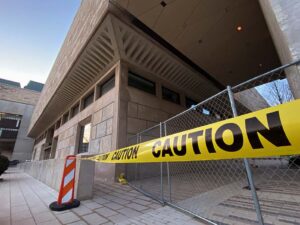
Construction fencing is erected around the Conrad A. Elvehjem Building exterior at the University of Wisconsin–Madison at dusk on March 14, 2022. Photo by Jeff Miller / UW–Madison
An evolving project
Construction on the renovation project began in 2023. UW–Madison Facilities Planning and Management staff managed the project from the university side, with McGowan Architecture of Madison as the primary architect. And since the Elvehjem is on the National Register of Historic Places as part of the Bascom Hill Historic District, a historic preservation architect was also involved, along with consultants in masonry and other specialties.
Building Envelope Professionals Group of Oregon used drone-based, 3D cameras and modeling technology to conduct initial visual assessments of the cladding. Combined with thorough manual inspection and laboratory tests, they graded the condition of each stone and determined it all needed to be replaced. Building Restoration Corporation handled the exterior stone removal and replacement, as well as installation of vapor barriers and insulation.
Grinstead says there were manufacturing delays with stone suppliers, along with quality control and color-matching issues. “They created a sorting system and the architects practically had to hand-select every stone,” she says.
On the roof, workers removed the sloped stone and added vapor barriers and insulation before recovering it with new stone. They removed and replaced copper gutters, sloped skylights, and flat sections of the roof that were previously covered by copper.
After work was completed on the roof, the Elvehjem began experiencing a new set of water leaks where there hadn’t been any before. Grinstead says the leaks prompted a redesign of the roof’s drain system, additional engineering reviews, and custom fabrication of unique components by local plumbing contractor H.J. Pertzborn.
The final major piece of the puzzle was removing and replacing the building’s leaking pyramidal skylights. The new skylights were designed, fabricated, and installed by Madison’s Lake City Glass in Spring 2026.
Now, with the project largely wrapped up, it’s the less noticeable things that will be bearing fruit for the art collection and visitors for years to come. Visitors may not be able to detect the more consistent temperature and humidity levels in the galleries, but it matters.
“That’s the hard part about it,” Grinstead says. “A lot goes into creating a proper environment for the collection that you can’t see. But for the patrons and the objects on display, that’s often the most important part.”