Chazen reopening aims to spark curiosity, insight, discovery
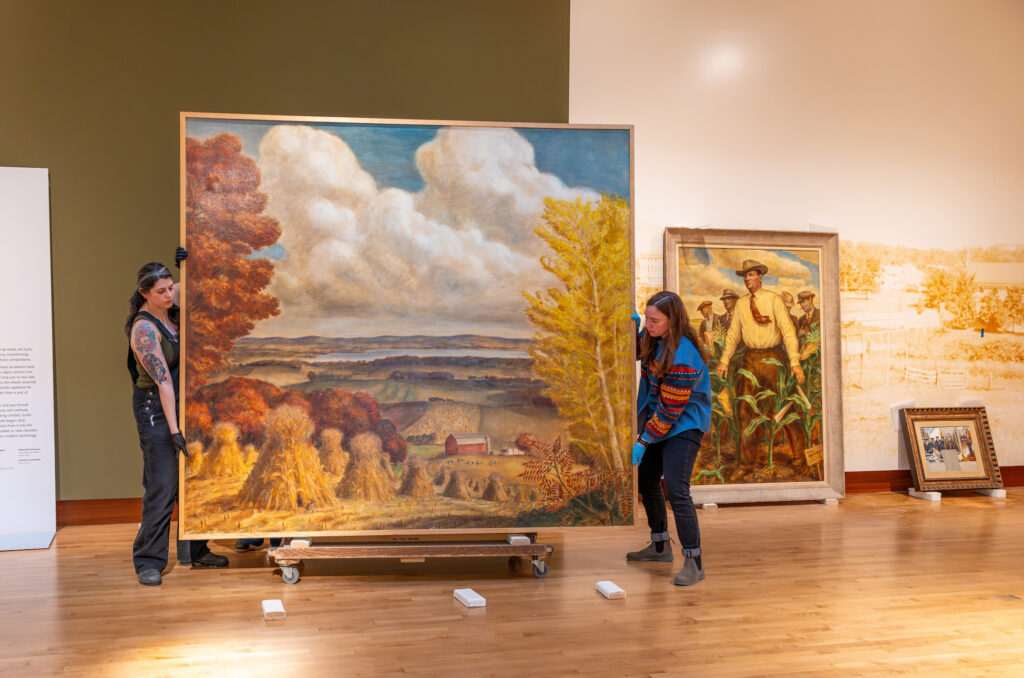
Chazen staff Kel Murray (left) and Leigh Holmes maneuver Wisconsin Farm Scene into place. The 1941 painting by John Steuart Curry serves as the focus object in gallery 11.
UPDATE: Temporary exhibitions on the first and second floors of the Chazen building, along with the Café, are open daily. We aim for a phased opening of the collection galleries on the third floors of both buildings starting in October.
When the doors reopen at the Chazen Museum of Art this fall, visitors won’t simply return to a familiar museum — they’ll step into a new way of seeing.
That’s because UW–Madison’s art museum has rethought everything —from the less-obvious links between its works to the ways people experience art. It emptied all of its collection galleries and is reinstalling paintings, sculpture, prints, and ceramics in ways that will feel less like a march through art history and more like a series of delightful discoveries.
Every gallery space will revolve around a single “focus object,” a work chosen to anchor connections across the museum’s collection of more than 25,000 pieces. Artworks from different centuries and cultures will appear next to each other. They’ll be linked by shared ideas, themes and approaches rather than strict timelines or geography. Visitor favorites will be presented in new ways alongside works that haven’t been on view before.
“It’s less of an instruction manual and more of an invitation,” says Chazen Director Amy Gilman. “We want it to feel more personal and approachable without sacrificing depth. It’s a chance for people to move through the galleries at their own pace, follow what catches their attention and trust their instincts about what they experience.”
The goal is to spark curiosity from the moment a visitor walks in, whether they are longtime museum goers, first-year students or someone wandering into an art museum for the first time.
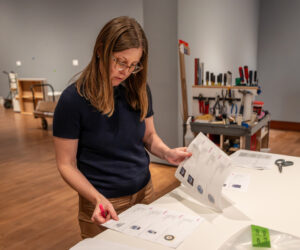
Katherine Alcauskas reviews a checklist as part of reinstallation work at the Chazen.
Chief Curator Katherine Alcauskas said the Chazen wanted to move away from traditional hierarchies that can make some works seem more important than others. “By centering each gallery on one object, we’re building outward from that piece and uncovering unexpected stories and connections throughout the collection,” she says. “We hope you’ll discover works you maybe never noticed before, or even leave with a new favorite artwork you didn’t expect to find.”
Chazen staff didn’t just think about the art itself. They studied how people actually experience museums: how long they spend looking at art, what kinds of information they want and what makes different types of visitors feel either welcomed or intimidated.
That research led to gallery text that will be more concise, comprehensive, and inviting. It informed art arrangement and gallery seating options, resulting in spaces that support lingering and reflection instead of rushing visitors from one masterpiece to the next. It also led to the Chazen launching a new mobile app this fall on the Bloomberg Connects platform. The app will greatly expand access to the Chazen’s collection by offering digital maps and wayfinding, audio artwork descriptions for low-vision visitors, exclusive audio features, and self-guided tours.
In some galleries, visitors may notice bold use of colors, patterns and graphics on the walls and in others, more familiar neutral and white backgrounds. Alcauskas says those choices were largely based on how the particular artworks were intended to be viewed. “Nineteenth century portraits would have been viewed against saturated colors or wallpaper, while the preference for white gallery walls emerged largely in the 20th century as a modernist curatorial convention,” she says.
The vivid, large-scale abstract painting “Pink Flutter” by Sam Gilliam will anchor a gallery space that looks at how artists use color and texture to create feelings of weightlessness and depth. Another gallery will place visitors inside a distinctly Wisconsin story.
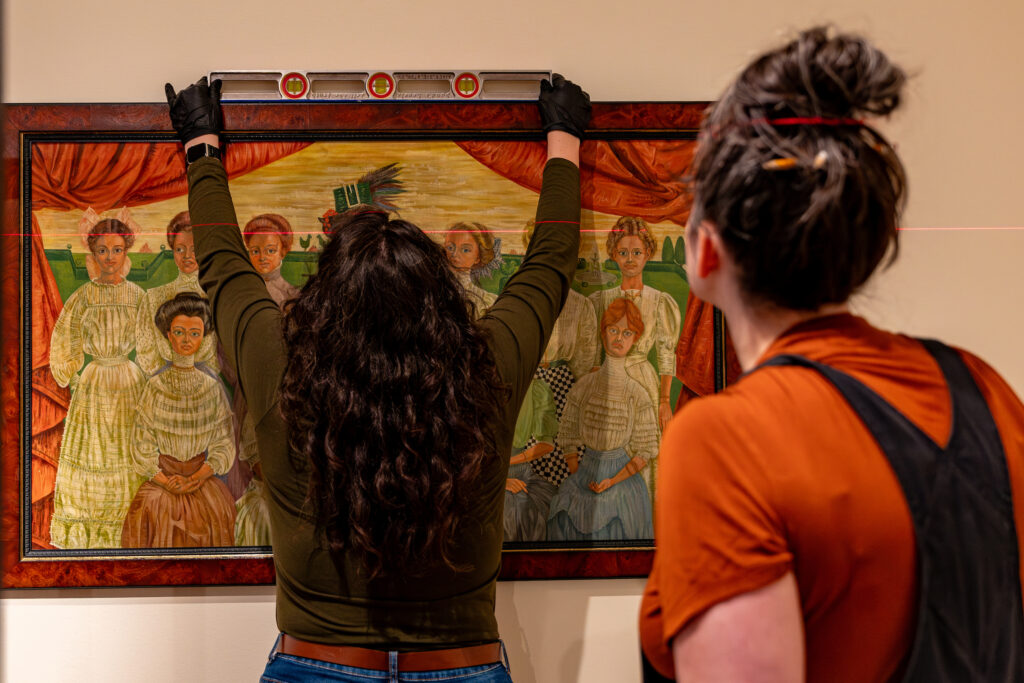
Chazen staff make final adjustments to Sylvia Fein’s Mama’s Music Class. One of 20 works by Fein in the collection, this painting serves as a constellation object to Wisconsin Farm Scene in gallery 11.
John Steuart Curry’s Wisconsin Farm Scene was painted in 1941 during his time as artist-in-residence at UW–Madison’s then-College of Agriculture (now College of Agricultural and Life Sciences). It will serve as a lens for exploring the Wisconsin Idea — the belief that university knowledge should improve lives beyond campus. It reflects not only a rural scene, but also the influence of university research on farming practices across the state.
Surrounding works will expand that conversation, connecting art to Wisconsin’s communities, landscapes and values past and present. The gallery reflects a broader goal of the reinstallation: showing visitors that art is not separate from everyday life, but deeply intertwined with it.
That idea resonates especially strongly on a university campus.
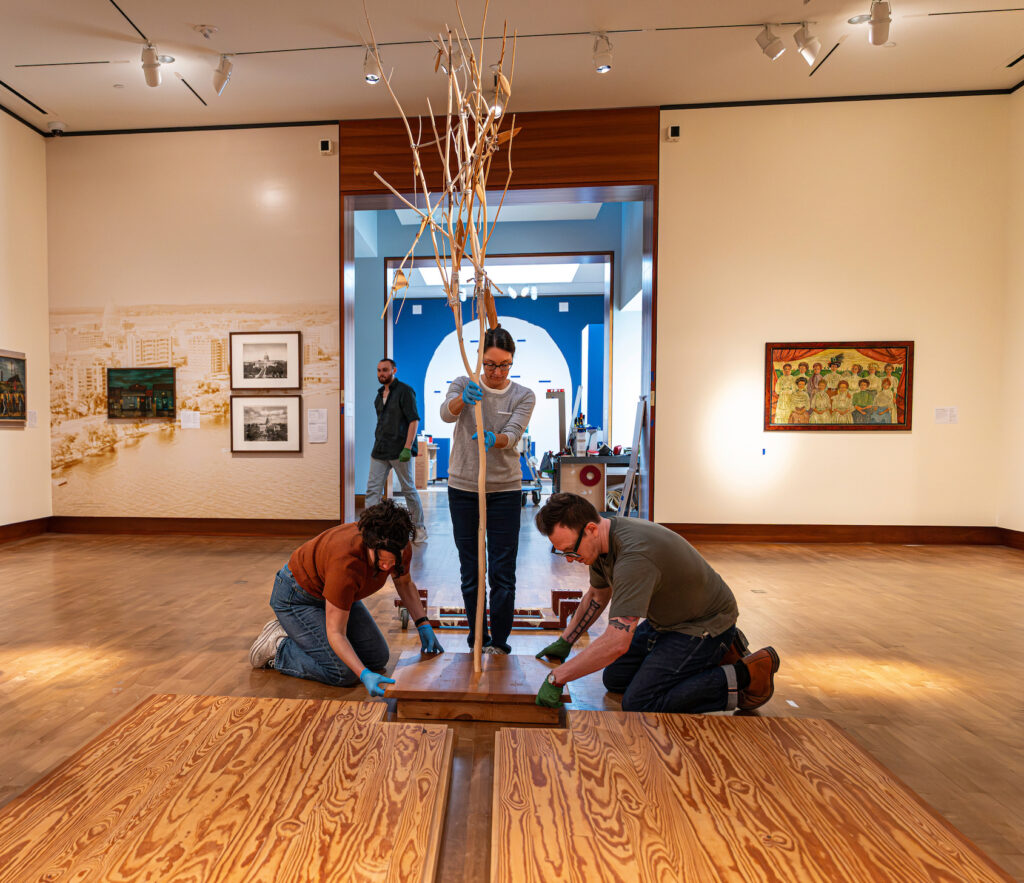
Staff install Feather Tree by Truman Lowe in gallery 11.
Because the Chazen sits at the heart of UW–Madison, the reinstallation project drew on expertise from across disciplines, including history, religious studies, material sciences and studio art. Faculty, graduate students, staff and community members all gave input that helped shape the galleries.
These collaborations reflect the Chazen’s role as both a public gathering space and a teaching institution. The museum plans to continue gathering visitor feedback after reopening, allowing the galleries to evolve over time as new research, ideas and acquisitions emerge.
“This whole project was a chance to rethink not just what visitors see, but how they experience a museum overall,” says Exhibition and Collection Project Manager Kate Wanberg. “We want to create spaces that feel welcoming and intuitive while still sparking deeper engagement and curiosity.”
For the broader Madison community, the reopening signals more than the rebirth of a beloved cultural space. It represents a renewed vision for what an art museum can be: a place to contemplate, converse and connect.