Pressing Issues Explores Printmaking as a Tool of Resistance in 1930s America
Economic disparity, labor unrest, gender inequality, racial violence and fears of rising fascism defined the 1930s — and remain strikingly relevant today. The Chazen Museum of Art examines artists’ critical commentaries on the injustices plaguing the country during the Great Depression era in “Pressing Issues: Printmaking as Social Justice in 1930s United States.” On view Sept. 8-Dec. 13, the exhibition presents approximately 40 rarely displayed prints from the collection of the Krannert Art Museum, who organized the show, as well as six works from the Chazen’s collection.
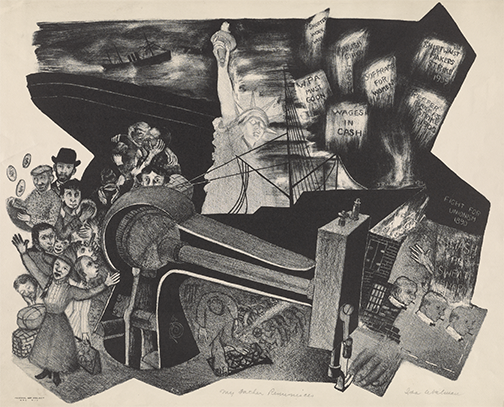
Ida Abelman, My Father Reminisces, 1937. Lithograph. Allocated by the US Government. Commissioned through the New Deal art projects, 1943-4-1.
During the Great Depression, as the country faced unprecedented economic collapse, visual artists were put to work through relief efforts that aimed to provide living wages and bolster the spirits of the general public. The Federal Art Project One (FAP), established by President Franklin D. Roosevelt, provided jobs to visual artists, musicians, actors and writers. The FAP was an arm of the New Deal’s Works Progress Administration (WPA), which employed 8.5 million people between 1935 and 1943. Many artists used the opportunity to depict scenes from everyday life while others used the platform to confront the country’s most urgent social and political crises. “Pressing Issues” foregrounds these artists, featuring works from Ida Abelman, John Stuart Curry, Minnetta Good, Harry Gottlieb, Riva Helfond, Carl G. Hill, Joseph Leboit, Nan Lurie and Herman Volz, among others.
“The artists in ‘Pressing Issues: Printmaking as Social Justice in 1930s United States’ used printmaking as a forceful tool to call out injustices shaping their world,” said Amy Gilman, director of the Chazen Museum of Art and senior director for the arts and media at UW–Madison. “Their work reminds us of the enduring role artists play in confronting oppression and the power of creativity in times of crisis. The Chazen Museum of Art invites visitors to consider how today’s artists continue to challenge systems of inequality and how art can help us envision a more just and equitable future.”
The exhibition is organized into four thematic sections: fighting for workers’ rights, women at work, condemning racial terror and denouncing fascism. Labor emerged as one of the most prevalent subjects in Depression-era art, often politicized through heroic depictions of male workers or sentimental portrayals of the rewarding value of manual labor. Yet many artists used printmaking to reveal the stark realities behind these narratives, drawing attention to exploitative working conditions — from child labor to the hazardous environments of coal mines and factories — and the daily economic struggles of those barely scraping by. William Gropper’s 1936 lithograph “Sweatshop” captures the bleak, weary faces of factory workers hunched over their machines in a powerful commentary on the exhausting toll of working-class life.
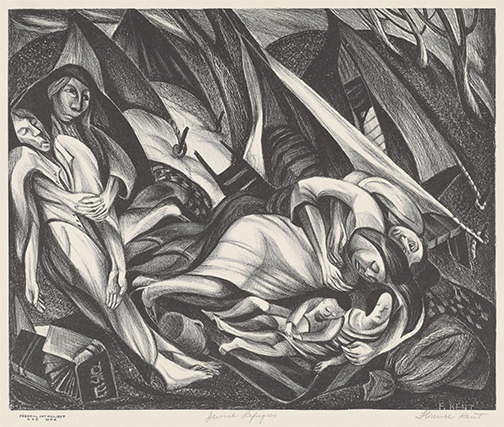
Florence Kent, Jewish Refugees, 1935–1943, lithograph, allocated by the US Government, commissioned through the New Deal art projects, 1943-4-210.
“Child Labor” by Ida Abelman highlights textile production and agriculture as two industries that often relied on child workers in the early 20th century. She visually merges scenes of girls sewing in factories with boys harvesting crops into the shape of a dollar sign, emphasizing how companies profited from underage labor. In 1938, the Fair Labor Standards Act aimed to curb these abuses by regulating youth employment. It banned dangerous work for anyone under 18, limited most jobs for children under 16, introduced a minimum wage of 25 cents per hour and capped the workweek to 44 hours.
Nan Lurie addresses race and unemployment in her surrealist-inspired lithograph “Technological Improvements.” The title refers to new machinery that led to layoffs and fewer job opportunities. The print depicts a line of African American men waiting outside a brick building near a construction site, unaware of a nearby sign that states, “No Help Wanted.” In the background, a giant construction claw appears to eject three ghostlike figures into the back of the formed line, symbolizing workers whose labor is no longer needed.
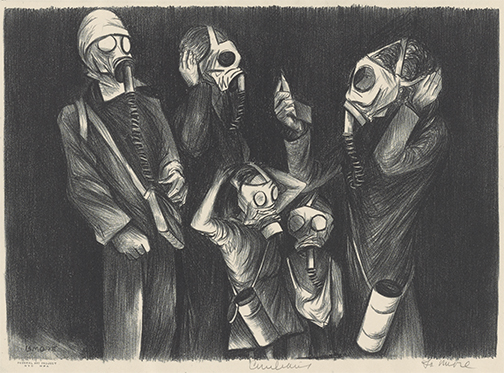
Chet La More, Civilians, ca. 1937. Lithograph. Allocated by the US Government, Commissioned through the New Deal art projects, 1943-4-231
Prints by Florence Kent, Chet La More and Joseph Leboit portray the struggles of Jewish refugees fleeing Germany, confronting rising fascism and the discrimination they faced amid a period of national isolationism. In “Refugees,” Leboit presents a harrowing scene of people forced to navigate a hostile world without guidance or support. At the center of the print, two women and a child are hunched over, carrying their few possessions as they traverse a desolate landscape of dead trees and destroyed buildings while a fierce wind sweeps around them. The roots of a fallen tree in the foreground seem to trap them, reinforcing the feeling of being both estranged from their homeland and disenfranchised in their new country.
Condemning and exposing the injustices of their time, artists of the tumultuous 1930s boldly used printmaking as a form of protest, commentary and resistance. “Pressing Issues” positions the prints as powerful reminders of the vital role artists play in shaping public consciousness, showcasing art’s ability to document, critique and inspire change.
“Pressing Issues: Printmaking as Social Justice in 1930s United States,” curated by Kathryn Koca Polite, is organized by Krannert Art Museum at the University of Illinois Urbana-Champaign. “Pressing Issues” is sponsored in part by the College of Fine and Applied Arts, University of Illinois Urbana-Champaign; the International Fine Print Dealers Association Foundation; and the Wyeth Foundation for American Art. Support for the exhibition at the Chazen Museum of Art is generously provided by The Anonymous Fund.