Opening in the fall, the presentation invites flexible exploration, highlights overlooked works and connects art to everyday life.
MADISON, Wis. — Constellations of artworks across time, media and cultures highlight common connections in a complete reinstallation of the permanent collection at the Chazen Museum of Art at the University of Wisconsin–Madison (UW–Madison). Debuting in the fall, the reimagined presentation unfolds across twenty-four gallery spaces, each anchored by a deeply researched focus object that invites close looking and layered interpretation. The reinstallation will also mark the reopening of the Chazen’s Elvehjem building, which has been closed for renovation since 2023.
Planning for the ambitious transformation began several years ago, as curators and subject matter experts undertook a deep exploration of the more than 25,000 artworks in the Chazen’s care. The collection, ranging from studio glass and figurative ceramics to modern Midwest painting and Japanese woodcuts, has been reconsidered through a lens that emphasizes making connections between art and daily life.
“The reinstallation allows us to showcase the strengths of the Chazen Museum of Art collection while offering a more enriching and holistic museum experience for our visitors,” said Amy Gilman, director of the Chazen Museum of Art and senior director for the arts and media at UW–Madison. “With the reinstallation, we hope to give visitors control of the rhythm of their journey and the confidence to choose their own path through the space and discover what resonates most with them.”
The reinstallation is rooted in visitor experience. Museum staff have incorporated research on how audiences engage with art — from how long guests linger to contemplate works to the amount of time spent reading and responding to interpretive text. Carefully considering what makes museums special alongside elements that might intimidate visitors, the Chazen team has worked to create an environment that will speak to a wide range of perspectives.
While the overall aesthetic of the galleries will feel familiar, visitors will notice a subtle but meaningful shift toward more intuitive, engaging encounters with art. Thoughtful design choices such as color palettes, materials, and seating support sustained looking and reflection, encouraging seamless interactions with objects and their accompanying labels. Chazen exhibition staff in collaboration with outside designers have developed gallery environments that complement the artworks while encouraging visitors to move fluidly through the renewed spaces.
“This reinstallation is a chance to rethink how a permanent collection can be experienced,” said Kate Wanberg, exhibition and collection project manager at the Chazen. “By aligning design, interpretation and visitor flow, we’re creating a flexible framework that feels welcoming while allowing individual objects to spark curiosity and engagement.”
The Chazen team took a collaborative approach from the start, leveraging its position as a museum embedded in a leading research university. The institution invited input from UW–Madison faculty, staff, and students across diverse fields—from history and religion to material sciences and studio art—to guide its reinstallation. Focus objects were selected and developed through proposals and conversations involving curators; UW–Madison graduate students, faculty, staff, and instructors; and community members.
With plans to continue gathering feedback through observation and surveys after the reinstallation opens, input from the community continues to be a vital throughline of the project. This flexible approach allows the museum to evolve over time, incorporating new research, perspectives and acquisitions while remaining responsive to its visitors.
“Placing focus objects at the center of each gallery allows us to build meaning outward from individual artworks,” said Katherine Alcauskas, the Chazen’s chief curator who is overseeing the reinstallation. “By stepping away from traditional hierarchies, we can highlight unexpected treasures from our collection and provide fresh entry points for visitors to discover future favorites and engage with original scholarship.”
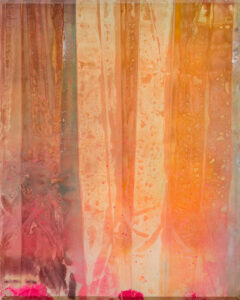
Sam Gilliam (American, 1933 – 2022), Pink Flutter, 1969, acrylic on canvas, 107 x 86 x 2 1/4 in., gift of Mr. and Mrs. Michael Gross, 1982.43
Among the featured works is Sam Gilliam’s Pink Flutter, (1969), a focus object slated for Gallery 17. A vibrant cascade of color and texture, the painting was created by folding and crumpling a still-wet canvas and leaving it overnight, allowing chance to interact with the artist’s guiding vision in determining its final composition. When unfolded, it reveals a mirrored pattern reminiscent of a Rorschach inkblot test. Mounted on a beveled stretcher that gives it sculptural presence, Pink Flutter challenges the boundaries of traditional painting. Created the same year as the first moon landing, the work evokes a sense of weightlessness, catapulting viewers from the familiar into a world of the artist’s creation.
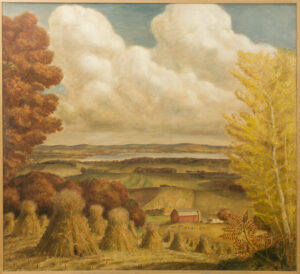
John Steuart Curry (American, 1897–1946), Wisconsin Farm Scene, 1941, oil on canvas, 88 7/8 x 97 in., gift of First National Bank and First Wisconsin Corporation, 1985.319
In Gallery 11, John Steuart Curry’s Wisconsin Farm Scene (1941) serves as a focal point for exploring the Wisconsin Idea, a guiding principle of UW–Madison since the early twentieth century that insists that education should influence people’s lives beyond the boundaries of the classroom. Curry’s idealized landscape reflects both the harmony between nature and the state’s rural residents as well as the influence of scientific research on local agriculture, with careful depictions of pastures and fields shaped by advances in crop rotation and soil management. Created during his tenure as artist-in-residence at the university’s School of Agriculture, the painting embodies the mutually beneficial relationship between the arts, education and rural communities. Additional works in the gallery reflect the people, landscapes, cities and farms as well as the interests and values of past and present Wisconsinites.
A very different perspective on art and daily life emerges in Gallery 2 with the York Minster Jug, a nineteeth-century factory-made ceramic vessel that unites modern industry with a nostalgia for Britain’s medieval Christian past. Its sculptural surface features pointed arches, slender columns and religious imagery, reflecting a time period when mass-produced objects carried both aesthetic and cultural meaning. Newly accessible to a growing middle class, such commodities helped shape public taste while anxieties over rapid modernization fueled a romanticization of Gothic art and architecture.
The object-centered approach builds on earlier initiatives such as re:mancipation, a multi-year project that reframed a single artwork from the Chazen’s collection as a catalyst to prompt dialogue and navigate complex issues.