- Date
- February 25, 2026
- Time
- 5 p.m.
- Location
- Chazen Auditorium, Chazen Museum of Art
- Description
-
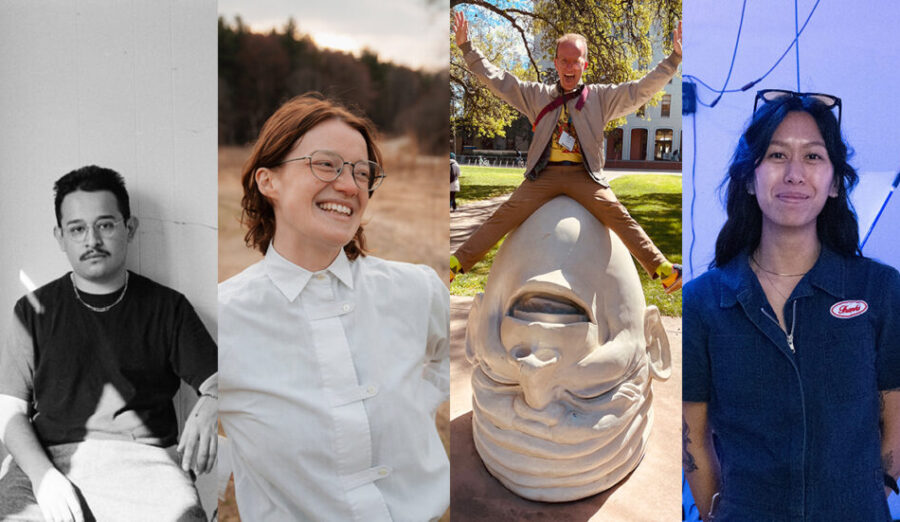
Our graduate students earning their Masters degrees will present their interdisciplinary work to the public. Explore their body of art, three-years in the making through the development of a rigorous studio art practice under the supervision of a faculty guidance committee, learning to cultivate professional practices that facilitate a sustainable career in the arts.
The Art Department Colloquium is a series supported by the Anonymous Fund and the Brittingham Trust. Visiting Artist lectures are held every Wednesday during the academic year, and are free and open to the public.
Discover the latest developments in fine art, craft, and design at the Art Department’s free public lectures by some of the nation’s most prominent artists, critics, and gallery and museum directors.
The UW–Madison Art Department’s graduate students earning their masters’ degrees will present their interdisciplinary work to the public. Explore their body of art, three years in the making through the development of a rigorous studio art practice under the supervision of a faculty guidance committee, learning to cultivate professional practices that facilitate a sustainable career in the arts.
Mark Almanza’s research revolves around the lens they view the world with, residing as a Chicano “third culture kid” in this in-between state of cultural belonging. This void of connection combined with the historical lack of Latine representation in the countless forms of media we consume, forces them to feel like an “observer” rather than an active participant in the culture. As a response, they use film photography, video installation, textiles/weaving, book arts, and referential analysis of media culture like films, TV, and music as tools to take back control of the narrative. Almanza is currently pursuing his MFA in Studio Art at the University of Wisconsin–Madison. markalmanza.photo
Swan Ferraro is an artist researching creative improvisation as a form of divination in the trans body. This manifests through the performance and documentation of somatic rituals within art installations. Ferraro seeks to queer spaces into creative sanctuaries to collectively dream of desirable futures. Through physically and spiritually envisioning new realities, imagination and improvisation are used as political tools for empowerment. In an effort to make healing practices more accessible, their art is meant to question what healing is and how it is felt. Ferraro has presented their research at Performance Studies International conference, SECAC arts education conference, and multiple improvisation festivals. Their paper is currently being peer-reviewed and published in Global Performance Studies journal. Ferraro will graduate in 2026 with an MFA in 4D Art from the University of Wisconsin–Madison. swanferraro.com
Joshuah Holbrook is a ceramic artist whose work is comprised of abstracting compressed, folded forms to capture an embodied perception and how bodily engagement shapes experience. Working with ceramic, industrial, and fiber materials, Holbrook’s intrigue is in precarity, the constant search of form through a visceral feeling of dissatisfaction and awkwardness. Working intuitively is a vital part of Holbrook’s process through engaging in pre-reflective experience or working without thinking through, using a half-knowledge where perception and action are intertwined. Where there is a battle between the will and the body, self-image and raw impulse, a confrontation of duality through multiple gestures that takes time, Holbrook creates a riddle inconducive to solving one. Holbrook earned a BFA from Georgia State University with a concentration in ceramics and is currently a ceramics MFA Candidate at the University of Wisconsin–Madison.
Daniella Thach is a Cambodian-American artist whose works collapse a violent past and volatile present to envision possible futures. They trace this history and the diasporic impact on their family to form a new, amalgamous identity. In combining new and obsolete technologies, Thach melds timelines across past and familial memory to imagine life and identity after genocide, assimilation, and the loss of heritage. Often spawned in darkened installations, Thach’s interdisciplinary work coalesces neon, video, sculpture, drawing, printmaking, and ephemera to conjure spiritual visages. The iconography of Cambodia becomes an anchor within a visual language that Thach can speak fluently, making up for the mother tongue they did not inherit. They long to understand the karaoke sung by their grandmother or to follow the steps of a dance no longer performed. Thach mirrors these traditions passed down from parent to child through craft techniques often passed from master to apprentice, echoing the ways in which we preserve culture. While unearthing unspoken family memories of life during genocide, Thach hopes to shed light on the forgotten history as 2025 marks the 50th year since the Khmer Rouge systemically persecuted and killed 1.5 to 2 million Cambodian people. Bringing forth this history is especially pertinent as we witness the current genocide within Palestine. Thach has exhibited works across America such as the Museum of Glass in Tacoma, Washington, The Minnesota Museum of American Art in St. Paul, Minnesota, and Zhou B Art Center in Chicago, Illinois. They were an emerging artist in residence at Pilchuck Glass School in Stanwood, Washington and Chautauqua School of Visual Arts, Chautauqua, New York. Their artwork has been featured in publications including New Glass Review, Sixty Inches From Center, and The Oxford Blue. daniellathach.com
- Contact
- 608-262-1660, artfrontdesk@education.wisc.edu
- Tags
- Art department event